Member Projects
Conservation in action from day one
Members of the Walker Bay Fynbos Conservancy have a long history of environmental custodianship. Since the Conservancy’s inception in 1999, they have recognised the importance of sustainable land management and the potential for everyday people to play a meaningful role in fynbos conservation. A major component of putting this ethos into action has been to tackle the problem of invasive alien plants.
Here, we highlight both new and well-established projects that are generating a positive impact for biodiversity.
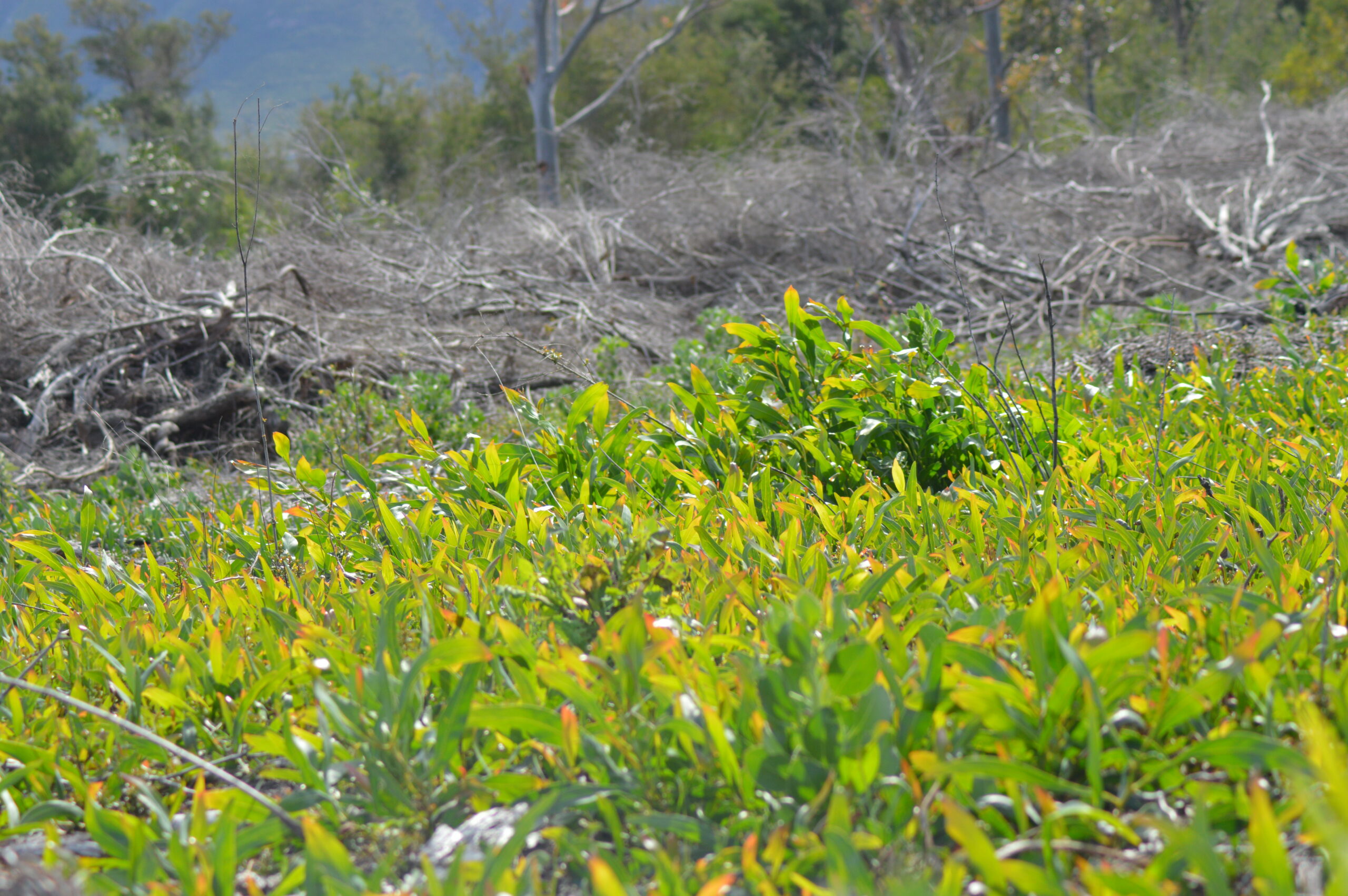
Invasive alien plant clearing, biochar and ecological restoration at Perivoli Lagoon House

Alien clearing and reforestation in the Uilkraal Valley
At the heart of the Conservancy lies the Uilkraal Valley. Nestled in the cool shade of the mountain slopes, this valley hosts a unique pocket of Southern Afrotemperate Forest, the largest portion of which sits on Platbos Forest Nature Reserve, a long-standing Conservancy member. Over millions of years, these forests have persisted in natural fire refugia, but much of their former extent has been decimated by excessive timber harvesting and land-clearing for crop cultivation. This, in turn, has eroded the natural forest-fynbos transition – a ‘buffer’ consisting primarily of shrubs that protects the forest from regular wildfires in the surrounding fynbos. Sadly, this has also made room for invasive alien plants, which greatly increase the impacts of fire on forests.
To restore and protect both forest and fynbos, properties in the Uilkraal Valley have banded together to remove invasive alien plant species and replant the forest edge with species that would have occurred there historically. Spearheaded by Francois Krige (Platbos) with support from Georgina Hamilton (Bodhi Khaya, Blomerus) and Maarten Groos (Farm215), the initiative has grown substantially to ensure the reinstatement of one of the last remnants of lowland forests in the Western Cape as well as the biodiversity it supports.
To mobilise the power of community, Platbos and Bodhi Khaya have partnered with Greenpop to host the annual Reforest Fest, where festival attendees can play their part by planting indigenous trees. A local alien clearing team, the Alien Army led by Johann van der Merwe, has also contributed by clearing over 60 hectares of invasive vegetation in just the last three months.

Clearing aliens for conservation and community at Coot Club
Although the 2025-2026 fires did not reach Coot Club directly, their impact was felt deeply. In the weeks and months that followed, Coot Club saw a noticeable increase in wildlife moving through the property, particularly in areas where alien vegetation had been cleared over the previous two years. Watching these restored spaces provide refuge for animals was both moving and affirming, and it reinforced the importance of continuing to create, maintain and protect wildlife corridors that connect Coot Club to neighbouring properties affected by fire.
At the same time, the fires highlighted the devastating role that invasive alien vegetation can play in intensifying fire behaviour. Seeing the damage experienced elsewhere strengthened Coot Club’s resolve to reduce this risk on their own land. Over the past year, Coot Club has continued clearing alien vegetation, connecting newly restored areas to those cleared previously in order to widen and strengthen these ecological corridors across the property.
A key part of this work has also been the protection and restoration of Coot Club’s milkwood forests, which serve as important habitat and refuge for wildlife, as well as natural buffers to fire in the landscape.
Alien clearing is carried out by teams from surrounding local communities, so this work not only contributes to ecological restoration and fire resilience, but also supports local employment and ongoing stewardship of the land.

Conservation servitudes and the Walker Bay Protected Environment
In 2022, eight Conservancy members came together to establish a Section 28 Protected Environment, collectively designating nearly 5,000 hectares for formal protection. This achievement was made possible through funding and expert assistance from the Grootbos Foundation and Fauna and Flora International.
Together with seven existing Section 23 private nature reserves and the magnificent Walker Bay Nature Reserve, this initiative has expanded the protected area to over 12,000 hectares of pristine and rare fynbos. This nationally proclaimed and internationally recognised conservation initiative ensures the long-term protection of this rich landscape, preserving its ecological integrity for future generations.
Additional Conservancy members, such as Brown Dog and Giant Periwinkle, have signed portions of their land into conservation servitudes, ensuring that future generations on these farms abide to the same ethos. By demonstrating commitment to conservation and sustainable land use, these proclamations enable landowners to access additional support from both the private sector and local government for alien clearing and fire management.

Volunteer hack groups at Groeneweide and the Pearly Beach Conservancy
Conservation thrives when local communities are empowered. At Groeneweide and the Pearly Beach Conservancy, weekly opportunities to join volunteer alien hack groups have been created as an outlet for people who care for their environment. Armed with the knowledge that fire not only stimulates the growth of indigenous fynbos, but also invasive alien plants, volunteers have a strong drive to protect our natural heritage. A strong sense of community and biodiversity stewardship emerges at these volunteer hacking events.
Volunteers give their time freely toward removing freshly germinated invasive alien plants, as the feeling of picking a seedling perpetuates the belief that every action, no matter how small, makes a difference in the long run.
All members of the community are welcome to join these hacks. Please contact us for more details.
Susanne Fuchs (landowner of Klein Paradijs and member of both the Walker Bay Fynbos Conservancy and Pearly Beach Conservancy) writes:
“Combatting invasive alien plants has been an ongoing commitment at Klein Paradijs since 2006. At that time, 90 hectares of the 139-hectare property were heavily infested with alien vegetation. Over the next two years, Princess Kutuka and her team of Siyanda Alien Clearing worked tirelessly to remove dense stands of various Acacia and Eucalyptus species, myrtle and pine. Since 2009, regular follow-up operations have taken place approximately every six months, with the most recent effort completed in November 2025.
Following the 2018 fire, intensive work was required to control the flush of invasive alien seedlings that emerged from the soil seed bank. Now, after the January 2026 fire, another major clearing campaign is needed. Princess and her team have already started the momentous task. Acacia species are particularly challenging because their seeds can remain dormant in the soil for 50 years or more. As a result, alien plant control can sometimes feel like a futile, never-ending task, testing both persistence and perseverance.
There is no qualification required to become a landowner, yet learning how to manage and protect the natural environment takes time, experience and guidance.”